

The Stone That Found Its Sound
Pimlo was wondering where the smooth stone had gone, and tonight the Old Willow holds a small, waiting quiet. Sprocket's river stone still fits a hand as if it belongs there, and someone very tiny may need it.
Pimlo was wondering where the smooth stone had gone. It had been in the hollow of the mossy log beside the lantern all afternoon, and now the hollow was empty, and Pimlo's small blue hands were sweeping through the leaves at the log's foot, searching.
Then came a scuffling, skidding sound, and Sprocket burst out of the ferns, his long legs tangling for a moment before he pulled up short, panting. "You didn't forget!" he said, tail wagging so hard it made his whole back wobble. "I ran all the way from the willow because I thought—well, I thought maybe you forgot, and I didn't want to wait one more night to show you the hanging branch that curls like a swing, and—" He stopped to breathe. "You're coming, aren't you? You promised."
"I promised," said Pimlo. "And I know exactly where your stone is."
It had rolled a little way under the log, and Pimlo fished it out and held it up. Sprocket's river stone was round as a bird's egg and perfectly smooth, the color of dusk on water, and when Pimlo closed one hand around it, it fit as though it had been waiting to be held.
"You kept it," Sprocket said, sounding surprised and pleased all at once.
"It's the best thing I own," said Pimlo, and slipped it into the pocket of a fallen leaf. "Come on. Show me the way."
They set off together, and Sprocket talked the whole way about the swing branch and the moss that was thick enough to sink into, and Pimlo listened and stepped where Sprocket stepped. The path slanted down toward Firefly Brook, where the fireflies were already drifting up from the reeds, slow and unbothered, and Sprocket hopped the smooth stones across the water one by one, and Pimlo hopped behind him, and the small splash sounds they made seemed to carry a long way in the hush of the evening.
Beyond the brook the ground turned soft underfoot, and then the willow was above them, its long branches hanging down in a curtain that swished aside when Sprocket pushed through.
Under the willow it was dim and green, the light filtered thin through the leaves, and Sprocket's mother lay along a bank of moss with her chin on her paws. Her eyes were open. They were open and looking at nothing, and Pimlo stopped quite still, because Sprocket had slowed to a halt too, and the whole willow room was so quiet that Pimlo could hear the leaves brushing each other far overhead.

"Sprocket," his mother said, without lifting her head. "Is that your friend?"
"It's Pimlo," Sprocket said, and crept close to Pimlo's side. His tail had gone still. "She's been awake since the moon came up," he whispered, so low that Pimlo had to lean in. "There used to be a cricket. A small one, no bigger than a crumb, that lived on a leaf right by her ear, and every night it chirped us all to sleep—it chirped and chirped and it was like a blanket, that sound, it was so nice—and tonight it just stopped." He looked up at the hanging branches and then back at Pimlo. "So nobody can sleep. It's too quiet in here. It's the wrong kind of quiet."
Pimlo stood very still with the leaf pocket pressed against his side, and under his hand the smooth stone was cool and round and patient. The willow room waited around them, silent and listening.
Pimlo stayed very still and let his eyes grow used to the dim green light. The willow leaves hung so close overhead that they made a soft green ceiling, and beneath it everything was waiting. Sprocket's mother had not closed her eyes. Sprocket himself had gone quiet beside Pimlo, his ears tipped forward, his tail curled around his feet.
Then Pimlo saw it. A leaf hung down from a low twig, close to the moss, and on that leaf something no bigger than a crumb was moving.

Pimlo leaned in, careful not to breathe too hard. The cricket was small and brown, with legs like threads and a body like a seed. It was trying to stand. It planted its tiny feet on the leaf and pressed down, and the leaf swung away beneath it, and the cricket slid sideways. It tried again. It set its feet more carefully this time, one and then the other, and the leaf tipped the other way, and the cricket's small body swayed and it caught itself just before it fell. Each time it steadied, its back lifted a little, as if a sound were gathering there, as if a chirp were climbing up through its legs and wings.
And each time the leaf tipped, the sound went out of it before it could begin.
Pimlo watched the cricket try five times, then six. The willow room held its breath around them. Somewhere far above, a branch creaked, and the cricket froze, then began again, patient as anything, planting its feet on the swinging leaf that would not hold still.
"It keeps trying," Sprocket whispered. "I heard it trying all evening. It never gets to finish."
Pimlo did not answer at first. He was thinking about the way the cricket's feet moved — how they reached and searched, feeling for a place to press down that would not slide away. The cricket was not doing anything wrong. It knew exactly what it wanted. It just could not find the ground that would let it stay.
Then Pimlo felt it against his side: the leaf pocket, pressed flat where he had crouched down. And inside the pocket, cool and round as a bird's egg, was Sprocket's river stone.
Pimlo drew it out slowly and held it in his palm. The stone was smooth all over, the color of dusk on water, and when he set it on his palm it did not roll or tip or slide. It simply sat. Round and still and quiet, the way the leaf was not. Pimlo turned it over once, and it stayed where he put it, and he thought of the cricket's feet, reaching and reaching for something that would not move away.
The cricket needed what the stone already was.
Pimlo closed his fingers around it and felt the cool of the brook still in it, and he looked up at the swaying leaf, and he knew. The cricket did not need a louder chirp or a bigger leaf. It needed a place under its feet that would hold still and let it begin.
Sprocket was watching him. "Pimlo? What is it?"
Pimlo held out the stone where Sprocket could see it, round and still in the dim green light, and the willow room seemed to lean in close to listen.
Pimlo held the stone out to Sprocket, and Sprocket leaned close to look at it, his whiskers brushing the dim green air.
"It's the one from the brook," Sprocket whispered. "The one I gave you."
"It is," Pimlo said. "Will you help me carry it? It needs two careful sets of hands."
Sprocket nodded at once, and Pimlo set the stone into the space between Sprocket's two front paws, keeping one of his own hands cupped underneath. The stone was cool and heavy, and together they carried it low, the way you carry something that matters, stepping slowly over the moss. The cricket's leaf swung above them, and the cricket went still, watching.
When they were close enough, Pimlo crouched down until his eyes were level with the leaf. The cricket's tiny face was turned toward him, its feelers held very still.
"Hello," Pimlo said, so quietly that even Sprocket had to lean in. "Would you like to try standing on this?"
He turned the stone a little in his hands so the cricket could see its round top, smooth as a drop of water. "It won't tip. It won't slide away. It will hold still under your feet for as long as you need."
The cricket looked at the stone. Then it looked at Pimlo, and its small head bobbed up and down, once, clear as a nod.
Behind them, Sprocket's mother lifted her head from the moss. She did not speak, but her ears came forward and her eyes stayed on the stone.
Sprocket's paws tightened around his side of the stone. "Where should we put it?"
"Right under the leaf," Pimlo said. "Where the moss is thickest. So it has a bed of its own."
They moved together — Pimlo lifting, Sprocket guiding — and set the stone down on the moss beneath the hanging leaf. It sank the smallest bit into the moss and stayed exactly where they placed it. The leaf swung above it, back and forth, back and forth, and the stone did not move at all.

Pimlo drew his hands away slowly. "There," he said. "Now it's ready."
The cricket crept to the edge of the leaf and paused there, its thread-thin legs gathered beneath it. The gap between leaf and stone was only a little way down, but the cricket measured it carefully, the way a small thing measures anything it does not want to fall from.
"Take your time," Pimlo murmured.
The cricket stepped down.
One foot touched the stone, then another, then all of them, and it stood in the middle of the round, smooth surface with its wings folded and its feelers lifted. The stone did not tip. It did not roll or rock. The cricket's feet went still, and it took a long, slow breath, and Pimlo felt his own breath go out with it.
Then the cricket chirped.
It was a small sound, hardly more than a thread of sound, but it was steady, and it did not break off. The cricket chirped again, a little stronger now, and the sound rose up through the hanging willow branches and filled the green room under them. It was the sound of a tiny creature that had found the ground it needed, and it went on, calm and even, like a heartbeat made of music.
Beside Pimlo, Sprocket's mother let out a long sigh. Her head settled back down onto the moss, and her eyes closed, and her breathing slowed until it matched the cricket's steady chirp. The worry went out of her face the way evening light goes out of a room — not all at once, but one small shadow at a time.
Sprocket turned to Pimlo, and in the dim green light his grin spread wide across his face, all his teeth showing, his ears tipped up as high as they would go. He did not say anything. He did not need to. He bumped his shoulder softly against Pimlo's, and Pimlo bumped him back.
They sat together on the moss and listened. The cricket chirped on, a small steady sound under the willow branches, and above them the leaves swayed slow and easy, and the quiet of the willow room had changed into a different kind of quiet — the good kind, the kind that comes when everyone has what they need.
Pimlo looked down at the stone, round and still with a small brown cricket standing on it, and he thought about how it had come from the brook, and how Sprocket had pressed it into his hands as a thank-you, and how it had waited in his pocket all this while for exactly this night.
Sprocket's mother was resting. The cricket was singing. And the promise, the one Pimlo had made and Sprocket had run so fast to remind him of, was kept all the way through.
Pimlo let his shoulders ease down and watched the leaf swing gently over the stone, and he stayed very still so the cricket could keep on chirping.
Pimlo lay back on the moss, and the moss received him the way a soft hand receives a tired face. It was not cold and it was not cool; it held the day's warmth in its deep green cushion, and it smelled of rain that had long since sunk into the earth. Beside him, Sprocket flopped down with a happy huff, his long legs folded every which way, his low tail curling around to rest against Pimlo's side.

"Is this how you sleep?" Pimlo asked. "All elbows and paws?"
"I don't know," Sprocket whispered. "I've never watched myself sleep."
Pimlo laughed, very quietly, because the willow room had gone quiet in a way that asked for quiet back. Sprocket's mother lay a little distance away with her breathing slow and even, one ear turned toward the cricket as if she were listening with it. The cricket still stood on the round stone, its wings folded, its feelers lifted, chirping out into the green hush one small steady note at a time.
Sprocket scooted closer, and his fur was warm where it pressed against Pimlo's arm. "Is the stone still there?" he whispered.
Pimlo looked. "It's still there. It hasn't rolled even a little."
"That's good," Sprocket said, and Pimlo could hear the last of the worry letting go of his voice. "I thought maybe it would roll away in the night and everything would go quiet again."
"Stones like that don't roll," Pimlo said. "They wait. That one waited in my pocket for a long time before it had anything to do."
Sprocket thought about that. His ears tipped, the way they did when an idea was turning over in his head. "I'm glad it had something to do," he said at last.
Pimlo turned on his side, and the moss rose up to meet his cheek. From down here the willow looked different — the hanging branches made a low ceiling of leaves, and beyond them the evening had turned the color of deep water. Fireflies drifted somewhere past the curtain, blinking and blinking, and each blink seemed farther away than the last.
The branches swayed. Not fast, not all together, but as though the tree were breathing, and each sway sent a slow shadow across the moss and then took it away again. Pimlo watched a shadow cross Sprocket's nose, and Sprocket's nose wrinkled, and the shadow moved on.
"Do you hear it?" Pimlo murmured.
Sprocket was quiet for a moment. "The cricket?"
"Not just the cricket. Everything."
Because the forest had not stopped. Past the willow curtain, Firefly Brook ran on, its water talking over its stones in the same patient way it had talked all evening. A breeze came through and set the leaves to their hushed clattering, and somewhere far off a branch creaked once and did not creak again. The cricket's chirp rang through all of it, small but clear, like a single bright thread sewn into a dark quilt.
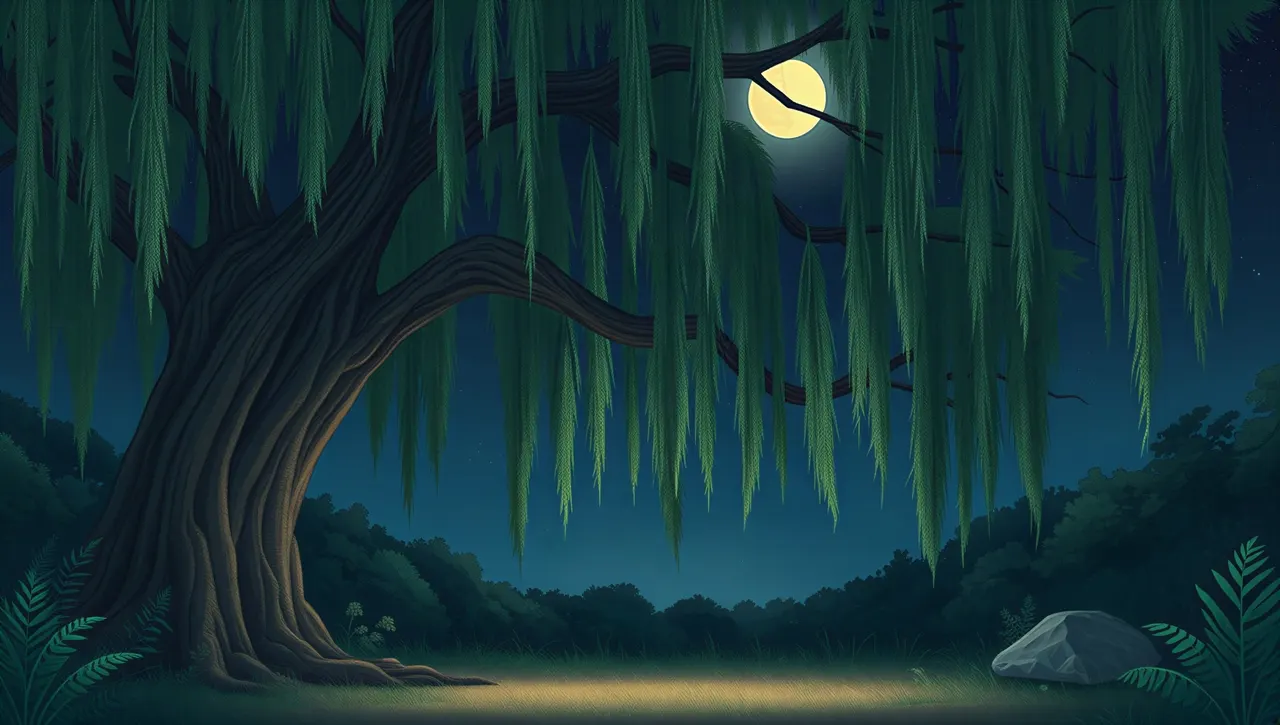
"It's the same sound as before," Sprocket whispered, "but it's different now."
"It's not alone," Pimlo said. "Before, the night was quiet and the cricket was missing from it. Now the cricket is back, and the night has it again."
Sprocket's paw found Pimlo's hand on the moss and rested there. "My mother used to tell me," he said, "that every night has its own sounds. She said if you lie still long enough, you can hear which ones are saying goodnight."
"Which ones are saying goodnight now?"
Sprocket listened. His ears swiveled, one and then the other, and his whiskers twitched with the effort of hearing. "The brook is," he decided. "And the leaves. And the cricket most of all."
Pimlo smiled into the moss. "Then we should say it back."
He lifted his head just enough to look across at Sprocket's mother. Her eyes were closed now, and her face had gone from worried to simply resting, the way a face looks when it has been given back something it lost. The round stone sat on the moss near her paws, and the cricket stood on it, chirping and chirping.
"Goodnight, cricket," Pimlo whispered.
"Goodnight, cricket," Sprocket whispered, and then, softer still, "Goodnight, Mama."
Pimlo settled his head down. The moss was deep enough that he could almost believe it had been waiting all along for someone to lie on it. The branches swayed above him, and their shadows crossed his face, and the shadows felt like a hand smoothing the day away.
"Pimlo?" Sprocket's voice had gone slow and heavy, the way voices go at the very end of a long evening.
"Hm?"
"Thank you for coming back."
Pimlo's eyes were closing. He did not try to keep them open. "I promised," he said.
"I know," Sprocket murmured. "But thank you anyway."
The cricket chirped on. Its sound was part of the brook now, part of the leaves, part of the slow sway of the willow branches drawing them both down toward sleep. Pimlo felt Sprocket's fur rise and fall beside him, warm and steady. He felt the moss hold him. He heard the small bright thread of the chirp, and then he heard it a little less, and then he heard it the way you hear things in a dream, and the willow swayed, and the night gathered everyone in, and the forest kept its new gentle sound.
Goodnight, Pimlo. The moss holds you, and the willow sways you down to sleep.