
The Lantern's New Promise
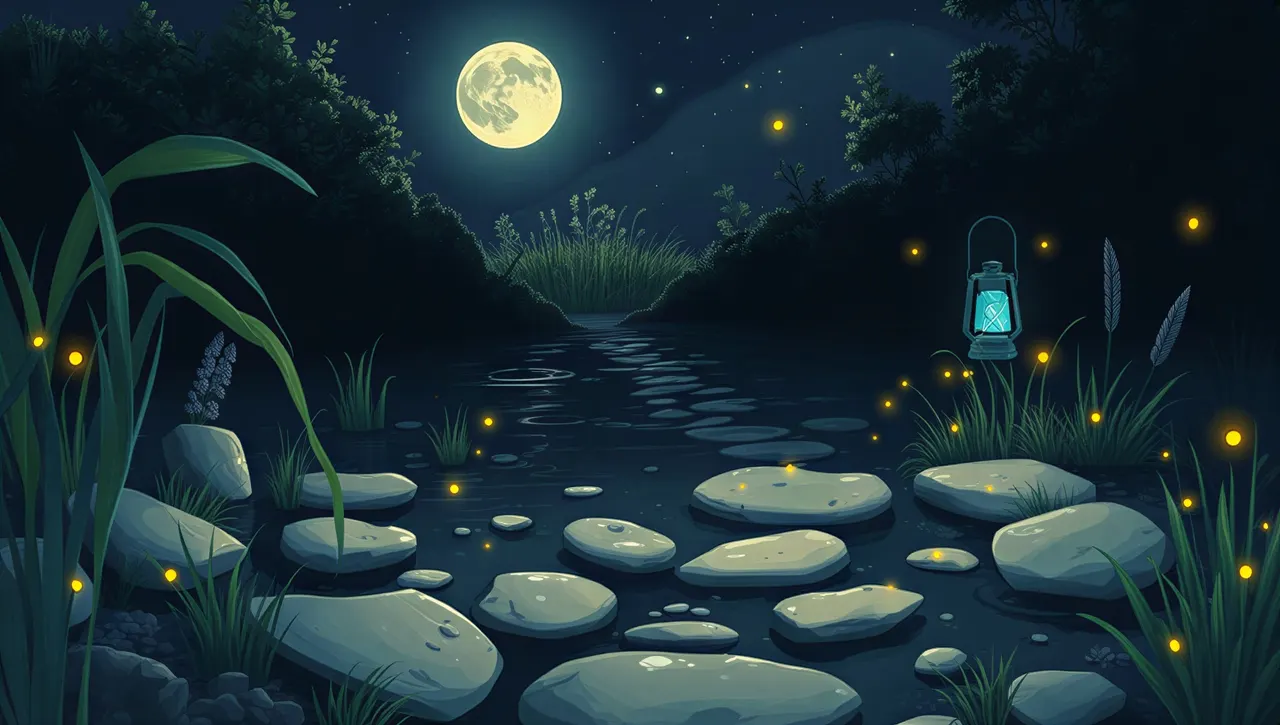
Pimlo and Sprocket return to the Moonlit Forest, where Sprocket's river stone still waits by the water. Tonight the fireflies can't find their way home, and a small promise begins.
"I brought the river stone back to the cricket, and he sang all evening," Pimlo said, stepping out from under the willow branches. "You should have heard him."
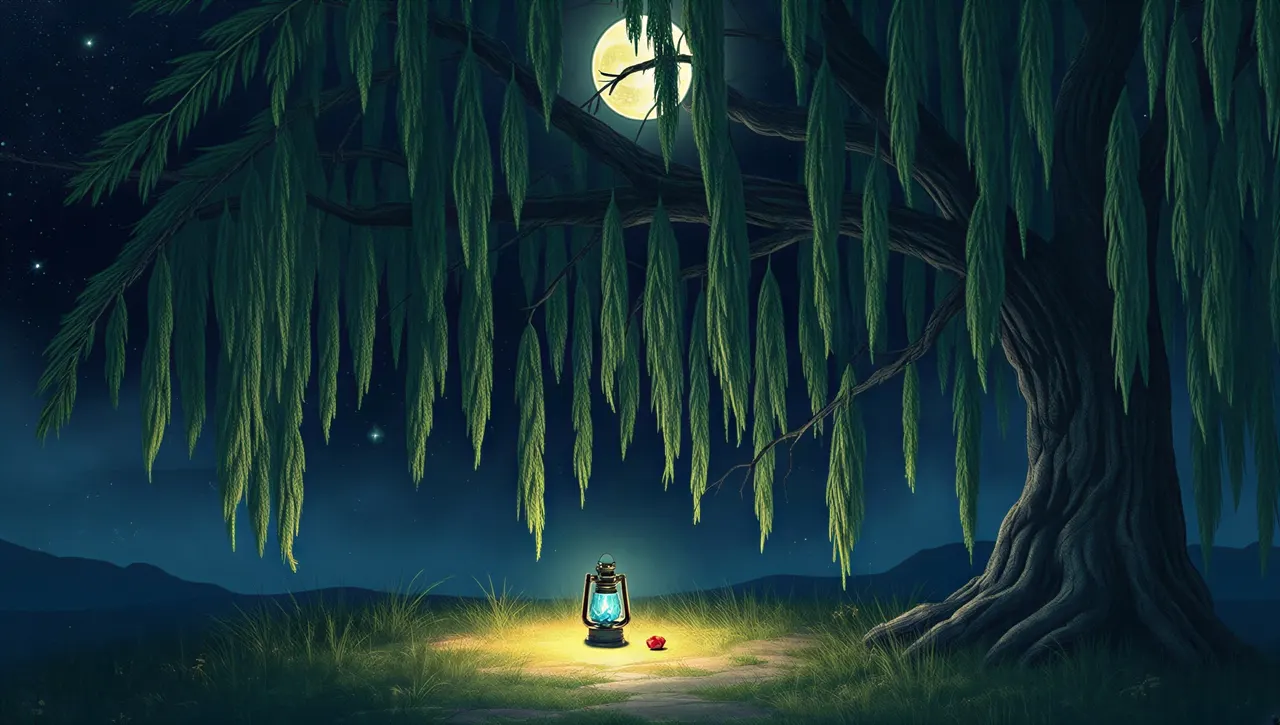
Firefly Brook answered with its own quiet talk, water sliding over pebbles, and Pimlo stopped at the bank the way he always did, toes at the very edge of the moss. He had walked this way to keep his promise, and the Old Willow still stood behind him with its curtain of leaves drawn shut for the night. Sprocket would be along soon. Pimlo had told him so.
Something moved over the water. Not a ripple — smaller than that, and higher up. Pimlo tipped his head back and watched a scatter of pale green lights circling just above the brook. They went round and round in a slow, worried loop, low enough that their reflections smeared across the water beneath them.
One of them drifted toward the far bank and stopped. It hovered, dipped, and then bumped against the reeds with a tiny tap, like a moth against a windowpane. The reed bent, the light slid off, and the firefly drifted back to where the others were circling. Another tried the same thing. Tap. Drift. Back.
"Oh," Pimlo said softly, and then, because it seemed like something he should say out loud, "you're trying to get across."
The fireflies didn't answer. They only kept circling, their lights brightening and dimming in a pattern Pimlo couldn't quite read. He crouched down and rested his chin on his knees. Their reflections came apart and put themselves back together on the moving water, never quite still.
Behind him, leaves rustled, and a pair of long legs came picking down the willow path.
"Pimlo! You came back!"
Sprocket bounded the last few steps and stopped just short of the moss, his tail sweeping low behind him. His ears were up and his whiskers were forward, and he looked as though he might burst from being pleased.
"I said I would," Pimlo said, and he couldn't help smiling. "I keep my promises."
"You do," Sprocket said, and then he noticed where Pimlo was looking. "What are they doing?"
Pimlo pointed. Together they watched a firefly make its try — the slow approach, the small tap against the reeds, the helpless drift back. "They can't find their way over," Pimlo said. "They keep bumping into the reeds and coming back. I've watched a whole lot of them do it."
Sprocket crept closer to the water and sat down beside him, so close their shoulders touched. "The other side is right there," he said, sounding puzzled. "It isn't far."
"It isn't far for us." Pimlo turned his head to watch the little lights loop and fumble. "But they can't see the way. They need something." He paused, chewing his lip. "Only I don't know what."
Sprocket was quiet for a while, which was something Pimlo liked about him. He didn't rush to fill the quiet with guesses. He sat and looked, and the brook talked on beneath them.
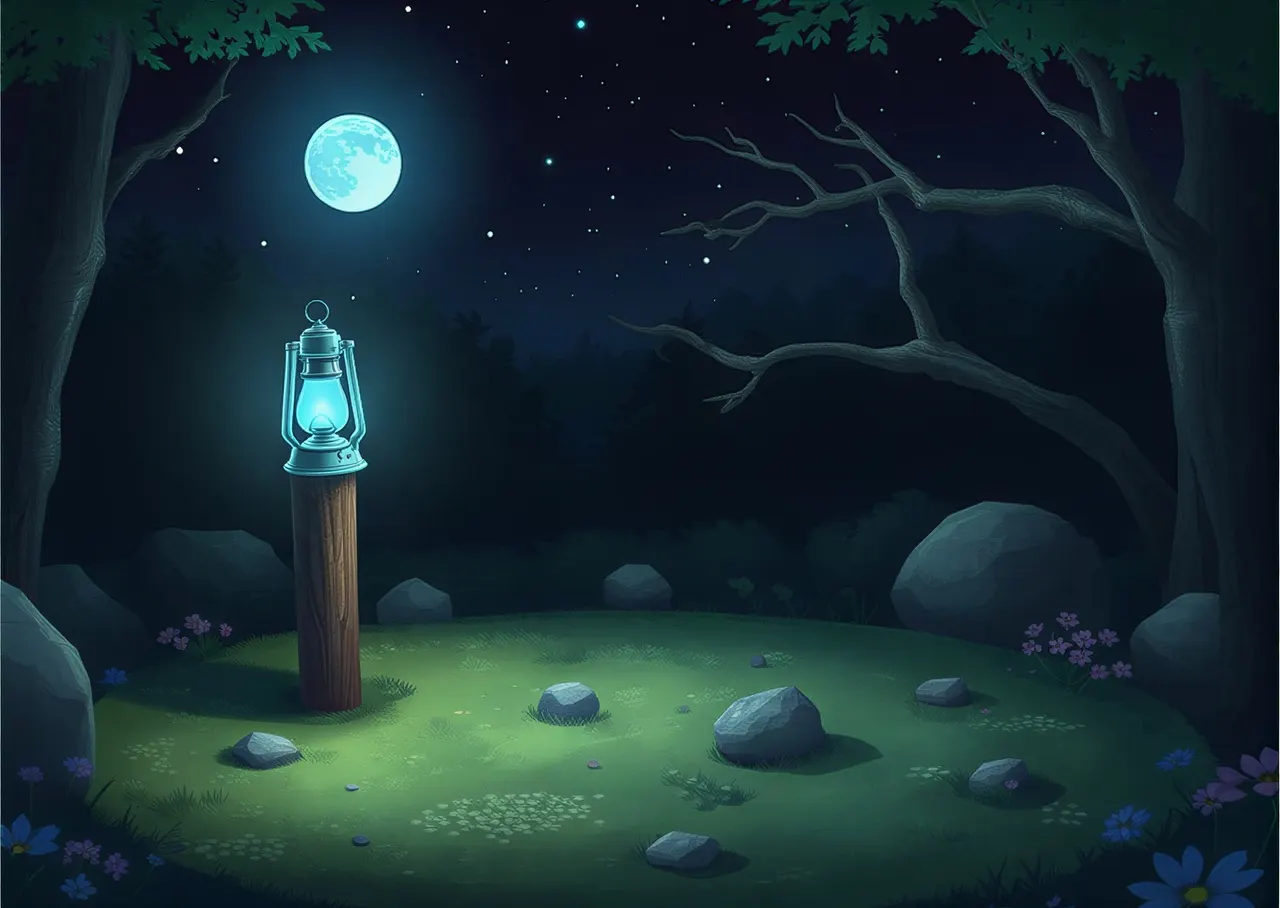
Then Sprocket's ears twitched. "The blue lantern," he said. "Down in the Lantern Clearing. It glows steady all night and never flickers. If they could see it, they'd have something to follow."
Pimlo looked at the fireflies, then back along the dark path that led down toward the clearing. "We could bring it here," he said slowly. "Set it at the edge where they could see it."
"Yes," Sprocket said, and he was already getting to his feet, tail sweeping. "I know the way. I could carry one side."
Pimlo stood up too, and brushed the moss from his knees. The fireflies kept circling behind him, patient and tired, their small lights catching on the reeds. "Then let's go get it," he said. "Before they wear themselves out."
Sprocket nodded, and together they turned from the brook and started down the path toward the clearing, where a steady blue light waited on its post.
The path to the Lantern Clearing ran downhill between ferns that brushed Pimlo's shoulders as he passed. Sprocket went first, his tail a low red-brown banner in the dark, and every so often he glanced back to make sure Pimlo was still there.
"I can see it," Sprocket said. "Look — through the trees."
The blue lantern hung on its low wooden post at the center of the round clearing, and the moss around it had gone the color of deep water. It did not flicker. It never did. Pimlo stood a moment and let his eyes get used to how steady it was, how patient, as though the light had been waiting all evening for someone to need it.
"We'll have to lift it off the post," Pimlo said. "Carefully."
"I'll take the bottom," said Sprocket. "You take the handle. If we go slow, it won't swing."
They did go slow. Pimlo wrapped both hands around the dark metal handle, and Sprocket crouched and slid his paws beneath the base of the lantern, and together they lifted it free of the post with a small wooden knock. The blue light swayed once across the ferns, then settled. It made a pool of color on the moss that moved with them as they walked, and the trees seemed to lean in to watch it pass.
Back at Firefly Brook, they set it down at the very edge of the water, where the moss gave way to pebbles.
"There," Sprocket said, stepping back. "Now they'll see."
Pimlo crouched low and waited.
The fireflies came. They drifted toward the lantern in ones and twos, their pale green lights brightening as they neared the steady blue. For a moment Pimlo was sure it had worked — they were gathering, they were close. But then one firefly dropped toward the water, meaning to land, and the brook shifted under it, and its light skidded sideways and it lifted away again. Another tried. Another. Each one dipped, touched the moving surface, and slipped, and rose, and circled back to try once more.
"They don't want to look," Pimlo said quietly. "They want to stop."
Sprocket crouched beside him. "Stop where? There's nothing out there but water."
Pimlo said nothing for a while. He sat down on the moss with his arms around his knees and simply watched, and Sprocket sat with him, and the brook talked on. A firefly would hover, choose its spot, lower itself — and the water would move, and the light would slide off, and up it would go again. Over and over, patient as anything, never learning, because there was nothing to learn from moving water.
Then Pimlo thought of a small brown cricket under the Old Willow, trying to chirp from a leaf that kept tipping and letting it slide.
"They need something still," Pimlo said, sitting up straighter. "Round and still, so their feet can hold. Like the cricket needed." He turned to Sprocket, and his voice came out quick with the idea. "The river stone. The smooth one under the Old Willow. It's round, and it doesn't tip, and it stays where you put it."
Sprocket's ears came forward. "The cricket's sitting on it right now."
"I know," Pimlo said. "So we'll ask him."
They left the lantern burning at the brook's edge — it would keep the fireflies company while they were gone — and took the willow path at a walk that was fast without being a run. The branches of the Old Willow hung down in front of them like a curtain drawn for the night, and Pimlo pushed through it gently with both hands.
Inside, on the moss, the round stone sat where it always sat. And on the stone sat the cricket, chirping. It was a small sound, thin as a thread, the sound that had been putting the willow room to sleep for as long as Pimlo could remember. The cricket's thread-thin legs were braced, its seed of a body still, and it chirped as though it had all the time in the world.
Pimlo knelt down so his face was level with the stone.
"Hello," he said. "I'm sorry to bother you. There are fireflies over at the brook tonight, and they can't get across. They keep trying to land on the water, and the water moves, and they slip right off. They need something round and still to rest on for a while." He put his hand flat on the moss beside the stone. "They need your stone. Just for tonight. May we borrow it?"
The cricket stopped chirping.
For a moment nothing moved under the willow branches. Then the cricket unfolded its legs, hopped down from the stone onto a wide green leaf that curved near the moss, and settled there. It tucked its legs, gave itself a small shake, and began to chirp again — the same thin thread of sound, just as steady, as though it had only stepped aside for a moment and meant to keep the room asleep from its new place.

"Thank you," Pimlo said, and he meant it. "I'll bring it back. I promise."
Sprocket was already crouched beside the stone. "It's heavier than it looks," he said. "We'll both take a side."
Pimlo took one side and Sprocket took the other, and the stone came up off the moss between them, cool and heavy and smooth as a held breath. The cricket chirped on from its leaf behind them as they carried the stone out through the willow curtain and back along the path, step by careful step, toward the brook where the blue lantern waited and the small green lights were still circling, still trying, still hoping for somewhere to land.
Pimlo knelt at the brook's edge and set the stone down where the moss met the water. It settled into the soft ground with a small, satisfied thump, round and pale in the lantern's blue, its top just above the moving surface. Sprocket crouched beside him, breathing a little hard from the carry, and together they watched.
The fireflies came almost at once.
They drifted in from over the water, their tiny green lights gathering above the stone in a loose, waiting cloud. One dropped low, hovered, and held there — close enough that Pimlo could see its light tremble. Then it rose again without landing. Another dipped. Another. They circled the stone in a slow wheel, brightening and dimming, brightening and dimming, but not one of them touched it.
"It's the right shape," Sprocket whispered. "Isn't it? It's round. It's still."
"It's the right shape," Pimlo said. But he was watching the fireflies, and something in the way they hovered made him sit back on his heels. They weren't slipping now. Nothing was sliding out from under them. They simply would not come down.
He thought about how dark it was out over the middle of the brook, and how the stone sat at the edge in the shadow of the reeds, and how a firefly would have to trust a gray shape in gray water with nothing to tell it the shape would hold.
"They can't see it," Pimlo said slowly. "Not really. It's just a dark lump to them. They don't know it's flat on top and it won't tip. They can't tell it's safe."
Sprocket looked at the stone, then at the fireflies, then at the lantern glowing behind them. His ears lifted. "The lantern's been lighting the water," he said. "But the water moves. What if it lit the stone instead?"
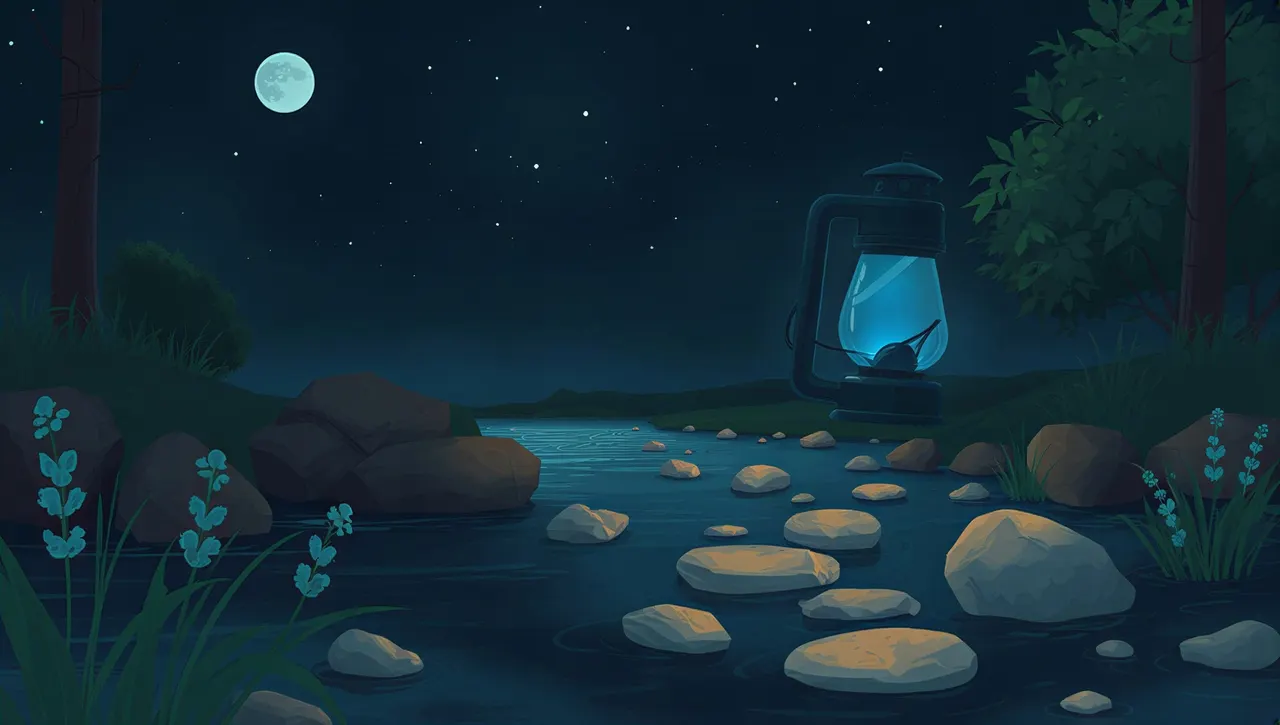
Pimlo turned. The lantern sat just behind them on the moss, steady as always, throwing its blue across the ripples. He got up carefully, took the dark metal handle in both hands, and lifted it — slowly, slowly, so the light would not swing wild and startle anyone. He carried it two steps and set it down again, angled so its glow fell full across the top of the river stone.
The change was small and complete. The stone's round face caught the blue and held it, bright and even, a smooth circle of light sitting perfectly still in the middle of all that moving water. It looked like a small blue moon that had decided to stay.
The fireflies saw it.
One dropped out of the wheel and came down in a slow, careful spiral, and this time its feet found the lit stone and held. It rested there a moment, its green light pulsing against the blue. Then another landed beside it. Then another, and another, until the stone was speckled with small green lamps, each one resting, each one still.
Pimlo hardly breathed. Beside him Sprocket had gone quiet as a held stone himself.
They rested a long while. Then the first firefly lifted off, and the others rose with it, and they did not scatter back over the water to circle and slip. They gathered into a loose, drifting line and went out across the brook in a slow procession, green light following green light, until the whole soft string of them had floated over the dark middle and reached the far reeds and the far bank beyond. The last light blinked twice and was gone among the trees.
"They made it," Sprocket said. His voice had gone small and glad.
"They made it," Pimlo said. He stayed where he was a moment, looking at the empty stone with its circle of blue still shining on it, and the far bank where the lights had gone. Then he reached over and put his hand flat on the stone's cool top, and it was steady under his palm, exactly as it had always been.
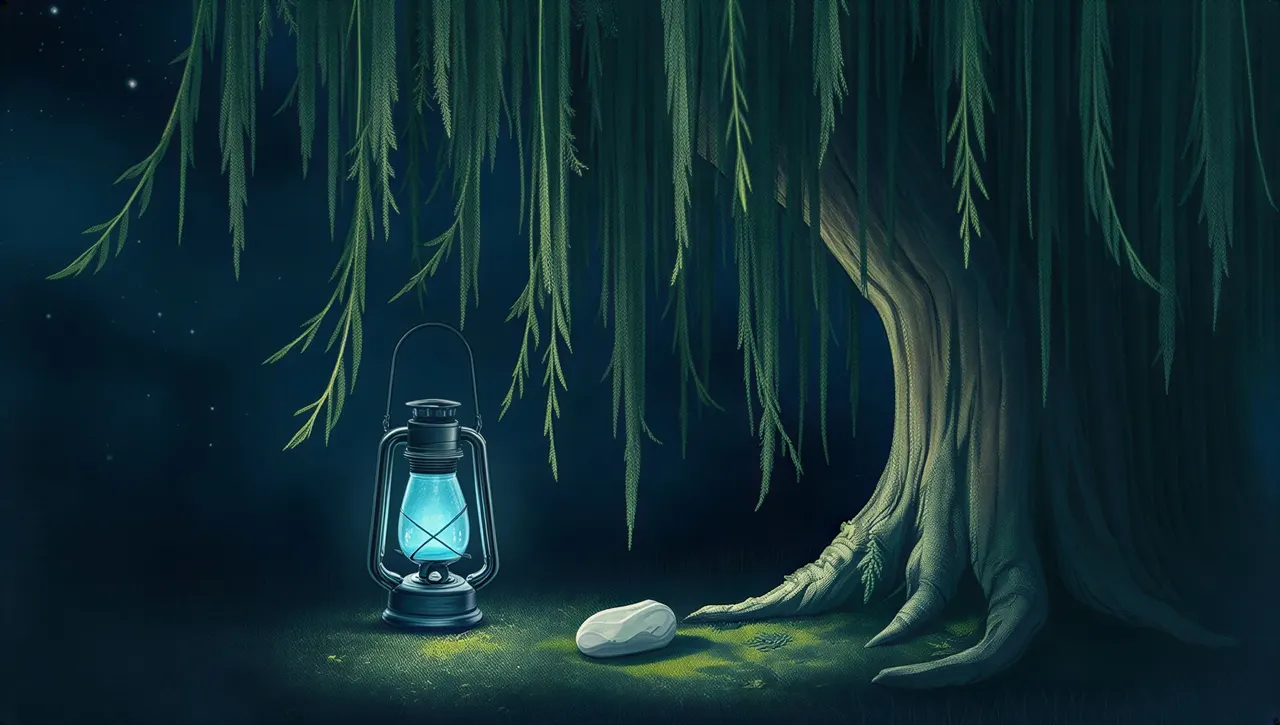
Pimlo lifted his hand from the stone and stood up, brushing the moss from his knees. The far bank was quiet now, and the brook went on moving past as if nothing at all had happened, which was how Pimlo knew the night had gone right.
"Ready?" Sprocket asked. He had already crouched to get his arms around the stone, his long tail sweeping a slow arc through the reeds behind him.
"Ready," Pimlo said, and bent to take the other side.
They carried it the same way they had brought it, one of them on each side, walking in small careful steps so the stone would not swing or thump against their shins. It was heavier going uphill, and halfway along the path Sprocket had to stop and set it down on the moss to blow out a long breath. Pimlo set down his side too and waited, and they both looked back at the brook lying flat and pale behind them.
"It looks smaller from here," Sprocket said.
"Everything does," said Pimlo, "when you're not standing right in it."
They picked the stone up again. The willow came into view slowly, its long branches hanging down in the dark like a curtain that someone had drawn for the night, and beneath it the moss was still pressed in a round hollow where the stone had rested for so long. They set it back down in that hollow, and it fit exactly, as if the ground had been waiting.
The cricket hopped down from its soft leaf before the stone had even settled. It landed on the round top and walked a small circle, feeling the flatness under its feet, and then it began to chirp — not loud, not hurried, just a low steady sound that filled the willow room the way a lantern fills a room with light.
"Goodnight," Pimlo said to it. "Thank you for letting us borrow it."
The cricket chirped once more, which Pimlo decided was a goodnight back.
There was still the lantern. Pimlo lifted it by its dark handle, and Sprocket walked beside him along the path to the clearing, where the moss was round and the post stood waiting with its empty hook. Pimlo set the lantern back on the post and let go, and the blue light spread out across the clearing again, steady as ever. It had never once flickered, all night, all the carrying and the setting down and the lifting up. It simply glowed.
"That's better," Sprocket said, looking around at the lit moss. "It looked strange out here without it."
They went back under the willow, where the branches hung their curtain and the cricket chirped, and Pimlo sat down on the moss beside the stone. Sprocket folded his long legs and sat beside him, close enough that his fur was a warm patch against Pimlo's shoulder.
"We should say something," Sprocket said. "About the stone. So it's a proper promise and not just a thing we did once."
Pimlo thought about that. "Whenever someone needs it," he said, "we'll share it. Together. You and me."
"Together," Sprocket said. "Even if it's the middle of the night, and even if it's heavy, and even if we have to carry it a long way."
"Especially then," Pimlo said.
They sat a while without saying anything else, and the willow branches swayed above them, slow, the way a curtain sways when a window has been opened somewhere in the house. The cricket chirped softly on its stone. Out past the brook, far away among the trees, a single green light blinked once and was gone.
Goodnight, Pimlo. Rest now, warm against Sprocket's fur, with the willow branches swaying slow above you.