
The Lantern and the Little Fox
Settle in, friend. Tonight Pimlo finds the Lantern Clearing gone quiet in a way it shouldn't be, and a small someone in the Moonlit Forest needs a little patience before they can be found.
Pimlo was halfway across the Lantern Clearing before he noticed that his feet had stopped making any sound.
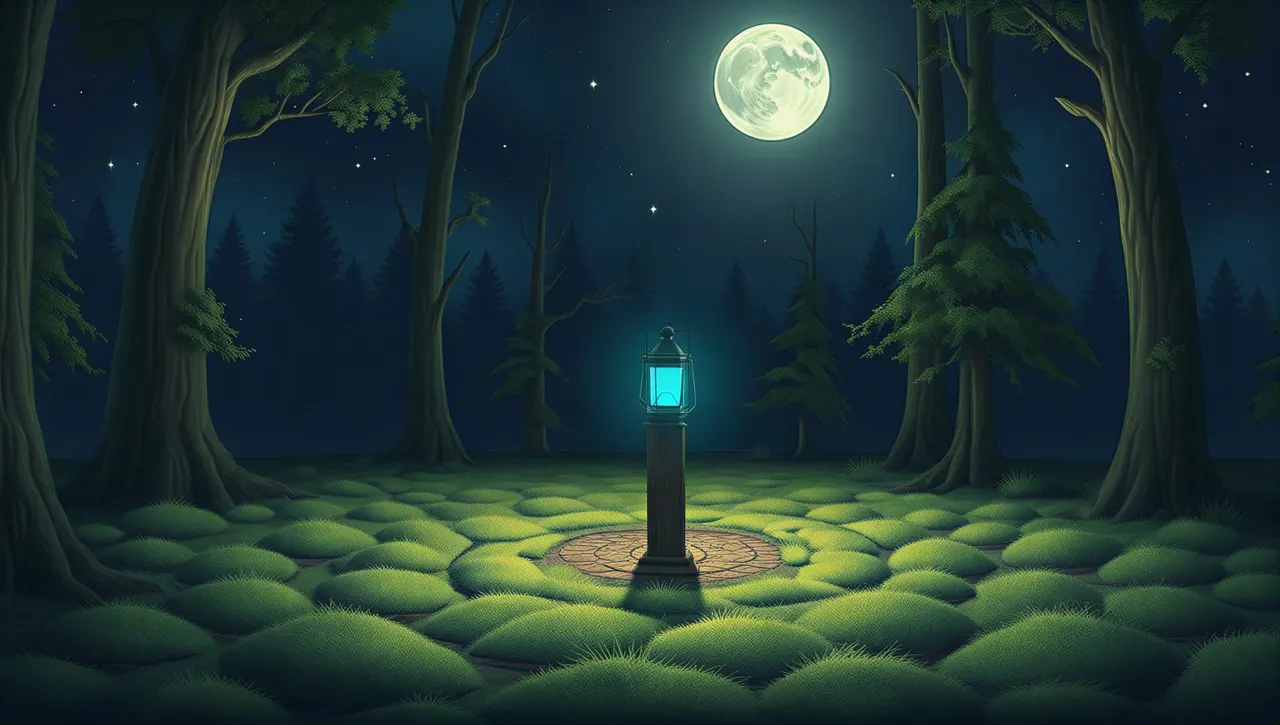
That was the first thing wrong. The moss under his toes had always whispered back to him, a small dry rustle with every step, and tonight it lay flat and silent, as if it were listening too. Pimlo stood still and looked up at the blue lantern on its low post. It was lit — but only just. The light sat low on the moss like a puddle that had nearly dried up, and it did not reach the edges of the clearing the way it usually did. The lantern post itself stood half in shadow, its smooth wood dark from the bottom up.
Pimlo took a slow step closer. The lantern did not brighten. It did not dim further either; it simply held its small blue glow close, the way someone might hold a candle behind a cupped hand. Pimlo tilted his head one way, then the other. His ears turned with the tilt. He had seen the lantern on nights when the whole clearing shone like a shallow bowl of water, and he had seen it on nights when it was simply there, steady and ordinary. He had never seen it like this — so small, so near to the ground, as though it were trying not to be noticed.
He reached out one short arm, not quite touching the post. The air around it was cool, but not cold, and it carried a faint smell of moss and rainwater. “Hello,” Pimlo said to the lantern, because it was the sort of thing he said when something seemed to be having a difficult time. The lantern flickered — one small pulse, up and then down again — and stayed dim.
Pimlo was still thinking about that flicker when a rustle came from the other side of the post.
It was a very small rustle. Not the dry whisper of wind through leaves, not the skitter of a beetle crossing stone. It was the sound of something trying to be quieter than it was, and failing by just a little. Pimlo lowered his arm and went around the lantern post slowly, one careful step at a time, and there, curled against the far side of the post, was a fox.
The fox was young, small enough that his whole body fit between the post and the first ring of moss. His tail was wrapped tight around his feet, and his ears lay flat against his head, pressed down as though he were trying to make himself smaller than he already was. His fur was a reddish brown, soft-looking, and it rose slightly along his back. He did not look up. His nose was tucked toward his tail, and his sides moved quickly, in and out, in and out, much faster than Pimlo’s own breathing.
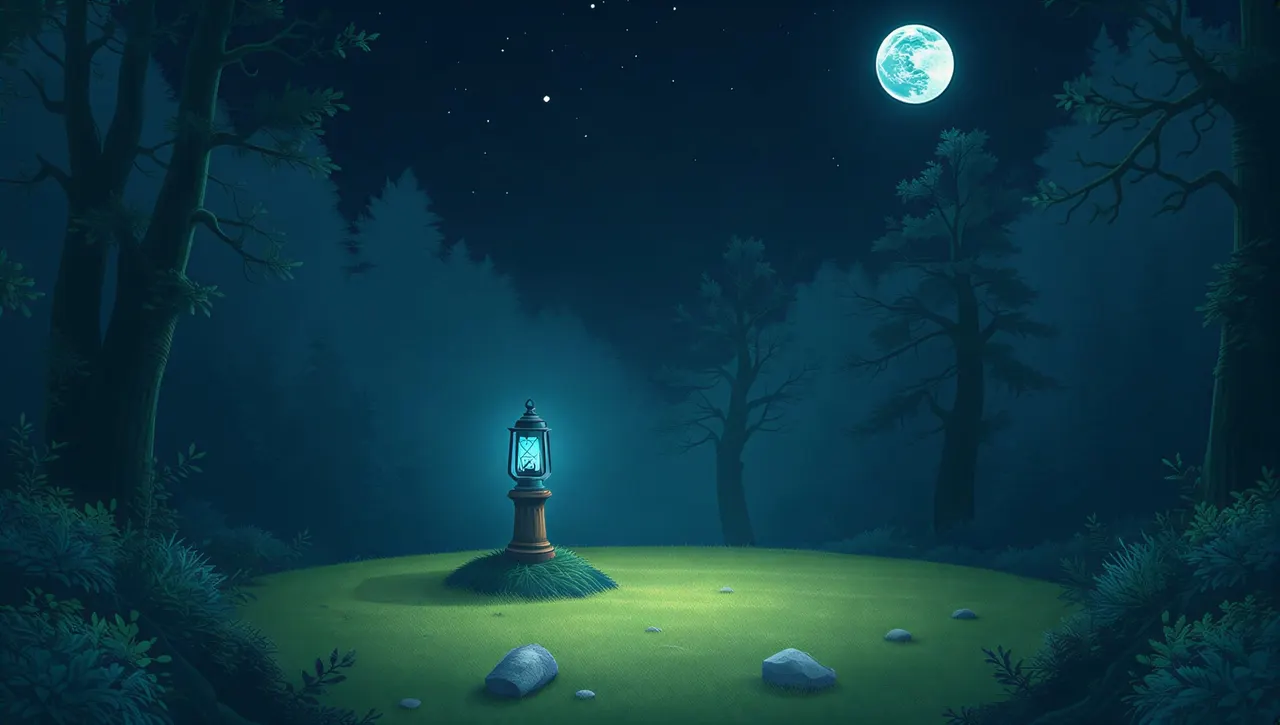
Pimlo did not move closer. He did not say anything at first. He simply stood where he was, at a little distance, and let himself be seen, and let the clearing stay quiet around them both. The lantern behind him pulsed once more, its blue light resting on the fox’s back as if it were trying to keep him warm and not quite managing it.
Pimlo lowered himself onto the moss, slowly, the way he did when a moth had landed on his arm and he did not want to startle it. He sat with his back against the curve of the lantern post, a full arm's length from the fox, and tucked his short legs to one side. The moss gave under him, cool at first, then not cool at all. He rested his hands on his knees where the young fox could see them.
"Hello," Pimlo said.
The fox's nose lifted by a whisker's width. His eyes came up too, dark and round and very wide, and he looked at Pimlo and then away, and then back, as if checking whether Pimlo was still there.
"Hello," the fox whispered. It was barely more than the sound the moss made. "I'm sorry. I didn't mean to be near your lantern."
"You're not in the way," Pimlo said. "What's your name?"
The fox swallowed. "Sprocket."
"Sprocket," Pimlo repeated, carefully, so it would not sound like a mistake. "I'm Pimlo. That's a good name for a fox. It sounds like something that keeps going."
Sprocket's tail tightened around his feet. "I was trying to keep going," he said. "But it got dark, and the dark is so much bigger than me. I can't find the way home. I've been sitting here a long while and I don't know which way it is. I don't know if I've gone past it or not gone far enough or — " His voice went thin and stopped.
Above them, the lantern flickered. Pimlo felt the change before he saw it: the blue light pulled in, drawing down small, sinking toward the moss until it was hardly more than a smudge of color on the ground. Sprocket made a tiny sound and pressed himself harder against the post.
Pimlo looked at the lantern, then at the fox beside it, then back at the lantern. The light had not gone out. It had only gone careful and low, holding itself close to the ground like someone crouching down to speak to a small person. And Sprocket was crouched too, folded and quiet, with his ears flat and his whole body saying lost.
Pimlo thought about that. He had seen the lantern shine wide and bright across the clearing on nights when the forest felt easy. He had seen it steady on ordinary nights. He had never seen it this small, and he had never before sat beside someone who could not find the way home. The two things sat next to each other in his mind and fit together like a stone in a stream.
He did not say any of this out loud. Sprocket did not need a puzzle explained to him. He needed the night to stop pressing on him.
Pimlo let his shoulders drop. He breathed in through his nose, slow, and out through his mouth, slower, and did not hurry it. "You can stay here as long as you like," he said. "This clearing is a safe place. Nothing in it will rush you."
Sprocket's sides were still going in and out too fast, like a small engine that could not settle. Pimlo did not move closer. He did not reach out. He just breathed, and after a while he said, very quietly, "You don't have to talk. We can just sit."
So they sat.
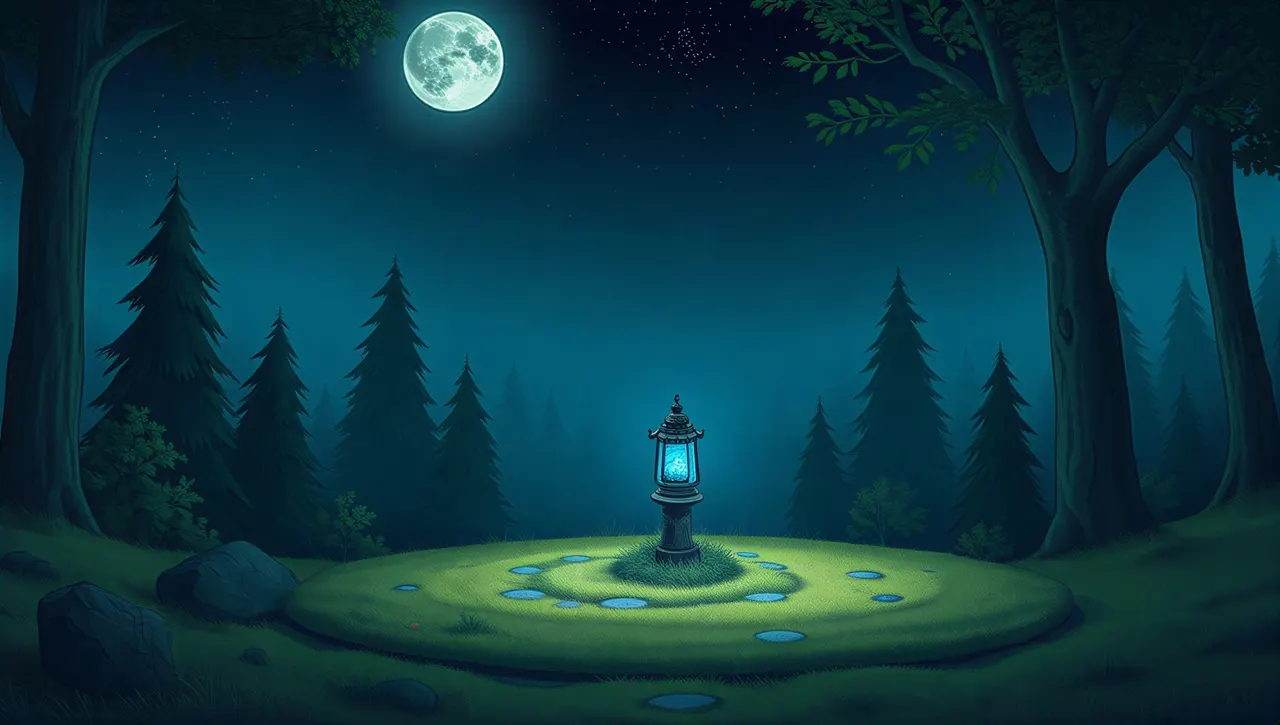
Pimlo counted his breaths without meaning to. One, and the moss was cool. Two, and the lantern post was solid against his back. Three, and Sprocket's breathing had gone from a flutter to a faster-than-usual but steady rhythm. Four. Five. The night held still around them, and somewhere far off a night bird called twice and then thought better of it.
"You're safe," Pimlo said, not loudly. "I'm right here, and the clearing is right here, and the lantern is right here. Nothing is going to happen to you while we sit."
Sprocket's ears stayed flat, but his tail loosened one turn, just one. His breathing slowed another notch, and another, until it matched Pimlo's for the length of a full minute. Then he lifted his head off his paws.
Above them the lantern changed. The light rose a little, the way water rises in a cup when the cup is set down level. It was still small and still low, but it was steadier now, a clear blue edge on the moss instead of a wavering smudge. Sprocket looked up at it and then at Pimlo, and his eyes were still wide but not quite so frightened.
"That's better," Pimlo said. "Look at that. It's still here too."
Sprocket's voice came out less of a whisper this time. "Does it do that all the time? Go small and big?"
"I'm not sure yet," Pimlo said honestly. "I'm watching it just like you are. But I think it likes to know how things are going." He let that sit, then asked, "Sprocket, what did you see on your way here? Before the dark got big. Anything you remember passing?"
Sprocket turned his head a little. His nose twitched, as though the question itself had a smell. "There was a brook," he said slowly. "I crossed it. It was slow, not a rushing one. The water hardly made any noise at all, just that little talking sound water makes when it goes around things."
Pimlo nodded, and did not fill the quiet.
"And there were lights over it," Sprocket said. "Little ones. Not like the lantern. Smaller, and they drifted. They went up and down and sideways, all on their own, and they kept blinking on and off like they were winking at each other." His ears came up a finger's width from his head. "Fireflies. My mother calls them fireflies. She says they only come out when the night is friendly."
"And the stones?" Pimlo asked. "Was there a way across?"
Sprocket's tail slid down off his feet entirely. "Smooth stones," he said. His voice had something new in it, something that sounded like remembering instead of worrying. "Round and smooth, all in a row, so you can hop from one to the next without getting your paws wet. I hopped. I remember hopping. There was one near the middle that wobbled a little, and I put my front paws on it and it made a tiny knock against the others, like a door." He blinked, and his ears stood up the rest of the way, both of them, and turned toward the trees as if they were pointing at something only he could see. "It was on the far side. I crossed the brook and then I was on the far side, and I kept going, and then — " He stopped, and his ears drooped, but only a little this time. "Then I couldn't remember the rest. But I remember the brook. I really do. The smooth stones and the little lights."
The lantern above them eased upward as he spoke, brightening by a shade, then another, its blue glow spreading a hand's width farther across the moss. Sprocket looked up at it, and then at Pimlo, and for the first time his mouth made the smallest curve, uncertain and small, but there.

"You remembered the brook," Pimlo said. "That's a start. We know the way that far."
Sprocket curled his tail around his feet again, but loosely now, and he did not press himself against the post. "I remembered the brook," he said, as though trying the words out. "I remembered the stones."
Pimlo stayed where he was, sitting on the cool moss in the rising blue light, and did not hurry him at all.
Pimlo stood up slowly, keeping his hands where Sprocket could see them. The moss let go of his feet with a small, damp sound.
"Show me," Pimlo said. "Show me the brook. I'll walk beside you the whole way."
Sprocket rose. He was smaller standing than Pimlo had expected, all long legs and thin ribs, his tail hanging low behind him like a dropped ribbon. He looked at the dark between the trees, and his ears went back.
"It might not be there," he whispered. "I might have made it up."
"It's there," Pimlo said. "You remembered it too well to have made it up. The wobbly stone. The little knock it made. Things you make up don't knock."
Sprocket turned that over. Then he took one step toward the trees, and another, and Pimlo walked at his shoulder, matching his pace so Sprocket would never have to hurry and never have to wait.
The path curved the way paths do, quietly, without announcing itself. Ferns brushed their knees. Somewhere overhead a branch sighed and settled. Sprocket's nose worked the whole time, reading the dark, and Pimlo watched him read it.
Then Sprocket stopped. His ears shot up, both of them, pointed forward like two small arrows.
"I know this," he said. "I know this part. There's a root here that goes across like a step, and I tripped on it and it didn't even hurt, it just surprised me — "
The path opened, and there was the brook.
It moved slow and unhurried over its bed, making that small talking sound water makes when it goes around things. And over the water, drifting up and down and sideways, blinking on and off as though winking at each other, the fireflies were out. Their lights were tiny and yellow and unbothered, and the water carried a copy of every one of them.
Sprocket made a sound Pimlo had not heard from him before. It was not a whimper. It was closer to a laugh that had lost its way and come out as a breath.
"The stones," he said. "Look. Look, Pimlo. There they are."
Round and smooth and set in a row across the water, pale enough to see. Sprocket went to the first one and put a paw on it, then hopped to the second, and the second held him. He hopped to the third, and the fourth, and when he reached the middle stone he paused and pressed both front paws down, and it wobbled and knocked against its neighbors with a small wooden sound.
"That one," Pimlo said from the bank. "That's the door."
Sprocket crossed the rest of the way and stood on the far side, dripping nothing, his paws dry, and turned around to look at Pimlo with his eyes bright. Pimlo hopped stone to stone after him, and the wobbly one dipped under his weight and knocked again, and then he was on the far bank too.
Behind them, back through the trees, the Lantern Clearing had changed. Pimlo could see it without turning around, because the light came all the way down the path now — a long blue reach laid across the moss and the roots and the ferns, spilling toward the brook as though it wanted to be certain they could find their footing.
"It's not even dark anymore," Sprocket said.
"It's still night," Pimlo said. "It's just that the lantern can see us now."
Sprocket's ears swiveled. He turned in a slow circle on the bank, sniffing, and then his whole body went still in a different way than before, still like a key turning in a lock.
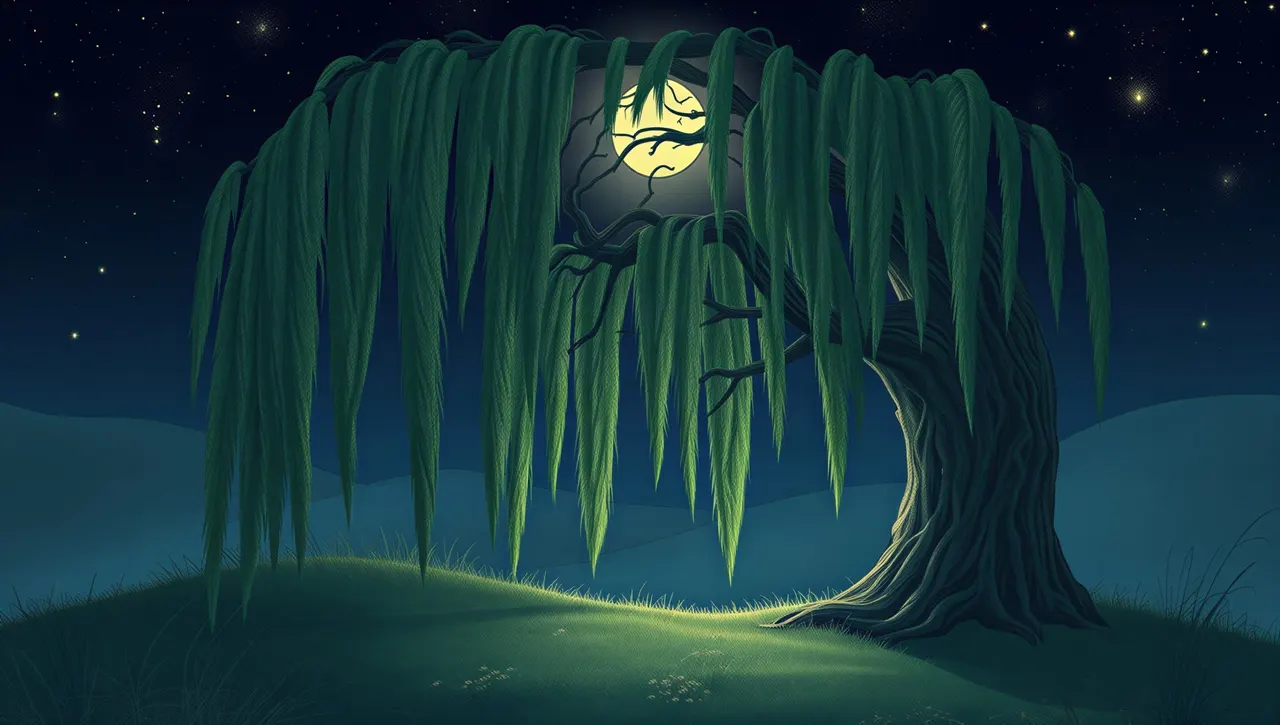
"The willow," he said. "Pimlo. The old willow. It's just past here — its branches come down all the way to the ground, they hang like a curtain, and behind the curtain it's dry and it smells like leaves and my mother's fur. It's right there. I know it's right there."
He was off before Pimlo could answer, not running away but running home, and Pimlo went after him with his short legs working, and the blue light stayed with them both the whole way, easy as a hand on a shoulder.
The willow stood where willows stand, at the edge of things, and its branches came down in long green ropes that touched the ground and made a room of the space beneath. Fireflies drifted between the ropes, slow as snow.
Sprocket did not stop to be polite. He pushed through the hanging branches with his nose and shoulders, and they swung and closed behind him, and Pimlo pushed through after.
Inside, the air was dry and close and smelled of leaves. The light came down through the branches in soft coins. And in the hollow at the willow's heart, a mother fox lay curled, and she lifted her head.
She did not startle. She looked at Sprocket, and a soft whine came out of her, low and long and glad, and Sprocket went to her and pushed his head under her chin and curled himself up small against her side, his tail wrapped over his nose.
"There you are," she said. It was hardly more than breathing. She looked at Pimlo then, over her son's back, and dipped her head once.
Pimlo dipped his head back. He stayed a moment, the way you do, and then he slipped out through the curtain of branches and stood in the night with the fireflies.
Far off, through the trees, the Lantern Clearing was full of light. The blue lantern stood on its post and shone the way Pimlo had never seen it shine — wide and steady and complete, laying brightness over every stone and root and fern, bright enough to reach the path, bright enough for anyone.
Pimlo crouched at the edge of the hollow and looked back through the curtain of willow branches. Fireflies drifted in the dark, blinking their small yellow blinks. The mother fox's breathing had gone slow and even, and Sprocket's too, curled small against her.
Pimlo began to rise, careful not to rustle the leaves.
"Pimlo," Sprocket whispered.
He lifted his head from his mother's side, and his ears came up. He wriggled free, quiet as a leaf, and trotted to where Pimlo waited. In the soft coin-light that came down through the willow, his eyes were bright.
"Wait," he said. "Just — wait here."
He ducked back into the den's hollow and nosed around, and Pimlo heard a small scratching, a small choosing. Then Sprocket came out again with something held in his mouth, carrying it the way foxes carry things that matter.
He sat down in front of Pimlo and set it on the ground between them.
It was a river stone, round and smooth, wet-looking in the willow light. Somewhere, it had been tumbled and tumbled until every sharp part of it was gone.
"From the brook," Sprocket said. "The one past the wobbly stone. I found it and I kept it and now I want you to have it." He nudged it closer with his nose. "For finding the way with me. For not hurrying."
Pimlo picked it up. It fit into his palm as though the palm had been made for it, and it was cool from the hollow's shade, the size of a big drop of rain.
"Thank you," Pimlo said. "I'll keep it."
Sprocket's tail gave a small wag, just once, and he looked back at the dark under the branches. "Will you come back?" he asked. "Not tonight. But sometime. Will you come back and see me?"
"I will," Pimlo said. "Right here, under the old willow. I promise."
"Under the old willow," Sprocket said, as though he were tucking it away somewhere safe. He pressed his nose to Pimlo's hand once, quick and warm, then trotted back through the curtain of branches, and they swung closed behind him.
Pimlo stood for a moment with the stone in his hand. Then he pushed through the branches himself and started back along the path.
The forest had gone quiet in that late way, when even the branches have stopped shifting and the only sound is the small one you make yourself. The stone picked up the warmth of his hand and held it. Fireflies drifted beside him a while, then went their own way. The brook kept talking softly to itself as he crossed the stones — the wobbly one dipping under his weight, knocking once against its neighbor, a small wooden sound in the dark.
Then the trees opened, and there was the Lantern Clearing.
The blue lantern stood on its low post and shone. Not dim, not flickering, but full and steady, laying its light all across the moss until the moss looked like its own quiet pond. The light reached the roots and the ferns and the path behind him, and it would reach anyone who came, on any night, feeling their way.
Pimlo walked to the middle of the clearing and sat down on the moss. He turned the stone over in his hand, and the blue light sat on it and made it shine.
Far off, beneath the willow, a small fox slept curled against his mother. And here in the clearing, the lantern kept watch, bright enough for anyone — his hand closed around the stone, warm now — bright enough for anyone who might need it.
Goodnight, Pimlo. The blue lantern keeps watch over the moss, bright enough for anyone who might need it.