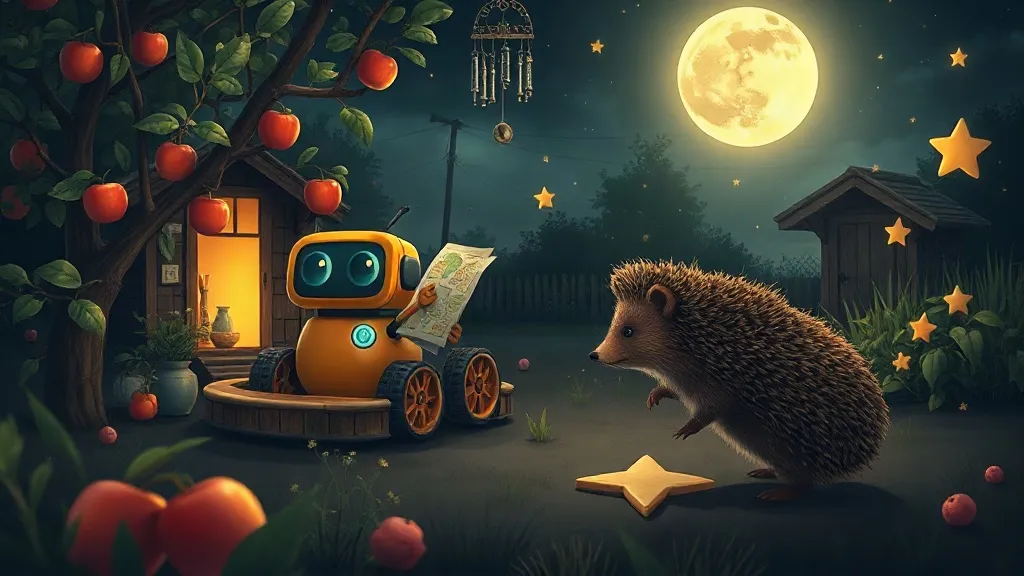
Nib was a small gardening robot, about the size of a watering can, with three soft wheels, two thin arms and a pair of round ears that could swivel in any direction. During the day, Nib watered the tomatoes, pulled up the weeds and counted the strawberries. But Nib had always wondered about something. What did the garden sound like at night, when everyone was asleep?
So one evening, as the sun began to set, Nib took out a fresh sheet of paper and a pencil, and wrote at the top in neat robot letters: A Map of the Night Garden. "I'm going to find every sound in the garden," said Nib, "and draw it on my map." Then Nib rolled quietly out of the shed.
The first sound came from the apple tree. It was a blackbird, sitting on the highest branch, singing the last song of the day. Its song went up and down, clear and sweet, like someone calling everybody home. Nib drew a little tree on the map, and beside it a bird with music notes coming out of its beak. "Sound number one," said Nib. "Blackbird, saying goodnight." The blackbird sang one last trill, fluffed its feathers and went quiet.
Nib rolled along the path to the pond. At first it seemed silent. But Nib swiveled both ears toward the water and waited. Plip. A tiny fish had come up to kiss the surface. Plip. Another one. And from the reeds came a low, creaky sound, like a door opening very slowly: a frog, clearing its throat. Nib drew the pond, a small fish with a ring of ripples around it, and a frog on a lily pad. "Sounds number two and three," said Nib.
By now the sky had turned deep blue, and the first stars were out. Nib's wheels made a soft crunch on the gravel, so Nib went very slowly, so as not to cover up any sounds. By the vegetable patch, Nib stopped. There was a rustle under the cabbage leaves. Then a snuffle. Then a tiny, contented grunt. Out from under the leaves trundled a hedgehog, nose twitching, on her evening walk. She looked up at Nib, sniffed one of Nib's wheels, decided Nib was not a slug, and trundled on. Nib drew a round, prickly shape with a pointy nose. "Sound number four. Hedgehog, snuffling."
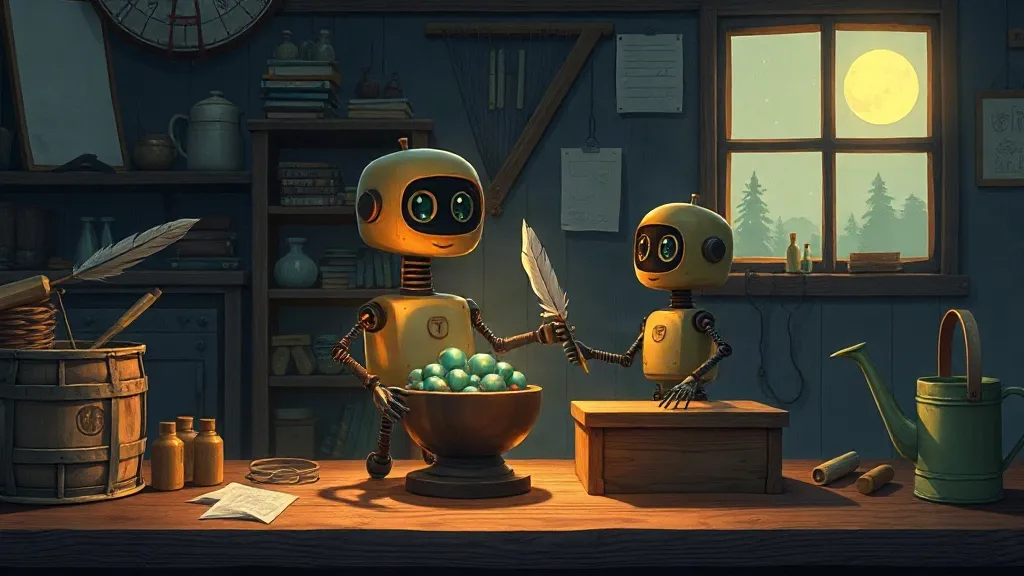
Nib rolled on to the old wooden shed. The sun had warmed its roof all afternoon, and now, as the night cooled, the roof was making small sounds of its own. Tick. Tick. Tick. The wood was settling down for the night, the way a person stretches before sleep. Nib had lived in that shed for years and had never noticed. Nib drew the shed with three small ticks above it and wrote: Sound number five. Shed roof, settling down. Nib felt rather pleased.
Next came the wind chimes hanging by the back door. There was hardly any breeze, but every now and then a breath of air went by, and the chimes rang softly, ting, ting-a-ling, as if they were talking in their sleep. Above them, a moth was bumping gently against the kitchen window, where a single lamp was still glowing. Bump. Bump. Nib drew the chimes and the moth, side by side. "Sounds number six and seven."
Nib rolled on, very slowly, past the flower bed. From somewhere deep in the long grass by the fence came a tiny, steady sound, like a very small clock being wound up: chirr, chirr, chirr. Nib leaned down and looked. It was a cricket, sitting on a blade of grass and rubbing its wings together, singing a song that was almost too small to hear. Nib drew the long grass and a cricket in the middle of it, with tiny lines coming out of its wings. "Sound number eight," whispered Nib, so as not to interrupt.
Then Nib stopped in the middle of the lawn and waited, perfectly still. The grass was getting damp with dew, and Nib's wheels felt cool. Above the garden, more stars had come out than Nib could count, and a thin slice of moon was rising over the roof of the house. For a long moment there was no sound at all, and Nib began to wonder if the map was finished.
Then Nib heard something far away, beyond the garden wall. Nib's ears swiveled all the way round. Hoo. Hoo-hoo. It was an owl, somewhere in the dark woods across the field, calling to another owl. A moment later, the other owl answered, even farther away. Nib couldn't see the woods on the map, so Nib drew a little arrow pointing off the edge of the paper and wrote: Sound number nine. Owls. Too far to visit. Saying hello to each other.
Nib rolled back to the middle of the lawn and looked at the map. It was full now: the blackbird and the fish and the frog, the hedgehog and the ticking shed, the chimes and the moth, the cricket in the grass and the owls beyond the wall. Nib had found more sounds than ever expected. But the garden was getting quieter and quieter. The frog had stopped creaking. The moth had settled on the windowsill. The kitchen lamp clicked off. Even the chimes had gone still.
Nib listened very hard, with both ears pointing up at the sky. And in the quiet, Nib heard one last sound: almost nothing at all. A soft hush, like the whole garden breathing out. It was the sound of everything resting. Nib thought for a long moment, then drew a big, gentle circle around the whole map and wrote in the middle: The garden, sleeping. "Sound number ten," whispered Nib. "The best one."
Then Nib rolled slowly back to the shed, tucked the map safely in the drawer and parked in the usual corner, beside the watering can and the trowel. Above, the roof gave one last small tick. Nib's ears swiveled down, Nib's lights faded to a soft glow, and the little gardening robot powered down for the night, listening to the garden sleep.
The end, for tonight.